
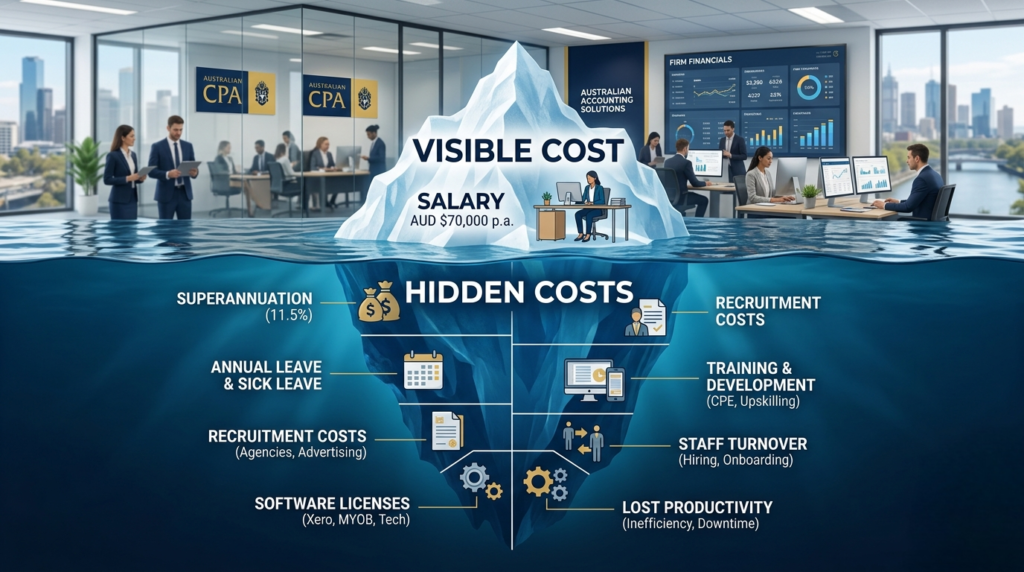
Hidden Cost of In-House Bookkeeping for Australian Accounting Firms — 8 Drains on Your Profit (2026)
Most firms see only the salary line. But when you add super, leave entitlements, software, and EOFY overtime — one bookkeeper costs your firm up to $115,000 AUD per year. Here’s the full breakdown.
The hidden cost of in-house bookkeeping for Australian accounting firms is one of the most consistently underestimated expenses in the profession. Ask any principal what their bookkeeper costs, and they’ll quote you a salary figure — maybe $65,000, perhaps $75,000 for someone with a few years’ experience in Sydney or Melbourne.
But that number is a fiction — a comfortable underestimate that quietly erodes firm margins year after year.
By the time you add compulsory superannuation, annual leave, personal leave, public holidays, WorkCover insurance, software licences, recruitment fees, training, and the senior accountant time spent reviewing their work — you’re not looking at $65,000. You’re looking at $95,000 to $115,000 AUD per year.
And that’s before the hidden operational costs: the EOFY overtime, the compliance errors on BAS lodgements that go to the ATO, the clients who leave because turnaround is too slow during tax season.
This guide is written specifically for Australian CPA and accounting firms — because not a single competitor in this space has done that. Every blog on this topic talks about US payroll or generic “business” outsourcing. This one talks about superannuation. About June 30. About Division 7A and trust distribution minutes. About the reality of running an accounting practice in Australia in 2026.
The Australian accounting workforce faces a documented talent shortage. Finding, hiring, and retaining a skilled bookkeeper has never been harder — or more expensive. The question isn’t whether you can afford to outsource. It’s whether you can afford not to.

What Is the Real Hidden Cost of In-House Bookkeeping for Australian Accounting Firms?
Let’s run the numbers that most firms never actually sit down and calculate.
According to ABS Labour Earnings data, a mid-level bookkeeper in an Australian accounting firm earns between $62,000 and $78,000 AUD in base salary depending on experience and location. Sydney and Melbourne sit at the higher end. Brisbane, Perth, and Adelaide slightly lower. But base salary is only the beginning.
The Full Loaded Cost Breakdown
| Cost Component | Basis | Annual Cost (AUD) |
|---|---|---|
| Base Salary | Mid-level, metro firm | $70,000 |
| Superannuation | 12% of salary (2026 rate) | $8,400 |
| Annual Leave | 4 weeks statutory + loading | $6,200 |
| Personal / Sick Leave | 10 days statutory average usage | $2,700 |
| Public Holidays | 10–12 days/year | $2,900 |
| WorkCover Insurance | ~1.5–2% of wages | $1,300 |
| Payroll Tax | Applicable above $700K–$1.2M threshold (state-dependent) | $0–$3,500 |
| Recruitment Cost | Amortised over 2-year tenure | $4,500 |
| Software Licences | Xero/MYOB/HandiTax per-user seat | $1,800 |
| Training & CPD | Onboarding + ongoing | $2,500 |
| Review Time (Senior/Manager) | ~3 hrs/week at $85/hr chargeable rate cost | $13,260 |
| Office Space & Infrastructure | Desk, equipment, utilities pro-rata | $6,000 |
| Total Fully-Loaded Annual Cost | $109,210 – $123,710 AUD | |
This table uses conservative estimates. Firms in Sydney CBD or Melbourne with higher-than-average salary expectations, higher payroll tax thresholds, or more frequent staff turnover will see fully-loaded costs exceeding $130,000 AUD per head.
“The salary line in your P&L is not what your bookkeeper costs you. The real number is nearly double — and most principals have never calculated it.”
The 8 Hidden Costs of In-House Bookkeeping Silently Draining Australian Accounting Firms
Beyond the numbers above, there are operational costs that never appear in your P&L as a line item — but they show up as reduced margins, delayed client work, and missed growth opportunities.
1. EOFY Overtime and Burnout
Australian accounting firms operate under one of the most concentrated compliance calendars in the world. June 30 triggers a cascade of entity returns, trust distributions, Division 7A calculations, PAYG summaries, and BAS lodgements — all within a narrow window. In-house staff get stretched beyond capacity, overtime costs spike, errors increase, and your best people start looking for an exit.
2. ATO Compliance Errors from Overworked Staff
A fatigued bookkeeper processing 40 company returns in the August–October window makes mistakes. BAS transposition errors. Incorrect GST classifications. Missed deductions. When those errors reach the ATO, the cost is not just the amendment fee — it’s your firm’s reputation with the client and, in serious cases, an ATO audit flag.
3. Knowledge Concentration Risk
When one person handles bookkeeping across 80 client files, your firm’s operational knowledge lives in their head. When they resign — which happens — you don’t just lose an employee. You lose months of institutional knowledge, client relationships, and workflow continuity. The average replacement cycle for a bookkeeper in Australia is 4–6 months.
4. Underutilisation Between Peak Periods
You pay a full-time salary 52 weeks a year. But bookkeeping work volume is not evenly distributed. February through May and August through October are peak periods. January, July, and November–December are significantly lighter. You’re paying full cost for partial utilisation during quiet months.
5. Senior Time Diverted to Routine Review
Every hour your manager or senior accountant spends reviewing a bookkeeper’s workpapers is an hour not spent on advisory work, client relationship building, or business development. At a chargeable rate of $150–$220 per hour, this is an expensive use of senior capacity.
6. Technology Cost Escalation
Xero, MYOB AccountRight, HandiTax, Class, BGL — Australian firms run complex software stacks. Every additional staff member adds per-user licensing costs. When you factor in tax software, practice management platforms, and document management tools, a single in-house head can add $3,000–$5,000 in annual software costs.
7. Inconsistent Quality Across Client Files
In-house bookkeepers develop their own habits. Without standardised SOPs, the quality of workpapers, reconciliations, and reports varies between staff members. This creates inconsistency that becomes visible during ATO reviews or when a manager must step into a file mid-engagement.
8. The Opportunity Cost of Not Scaling
Perhaps the most damaging hidden cost is the clients you couldn’t take on because you didn’t have capacity. Every potential engagement turned away — or accepted and delivered poorly — because your team was already at capacity represents real, measurable lost revenue.
The Australian EOFY Problem That No One Else Is Talking About
Every blog in this space talks about “peak season” in generic terms. Here’s what peak season actually looks like for an Australian accounting firm — and what the ATO Tax Agent Lodgement Program actually requires of your team each year:
Your in-house bookkeeping team is sized for average workload. But Australian compliance calendars create 4–5 peak months per year where demand exceeds capacity by 40–60%. You either overpay year-round for buffer capacity, or you under-deliver during peak. Neither is acceptable.
In-House vs Offshore: The Real Numbers for Australian Firms
Let’s put both models side by side — not with generic metrics, but with numbers relevant to the Australian market in 2026.
❌ In-House Bookkeeper
- $70,000–$80,000 base salary AUD
- 12% compulsory superannuation
- 4 weeks annual leave + loading
- 10 days personal leave per year
- WorkCover insurance obligations
- Payroll tax (state-dependent)
- $3,000–$5,000 software licensing
- Recruitment cost every 2–3 years
- Senior review time = diverted capacity
- Fixed cost in quiet months
- Cannot flex for EOFY peak demand
- Single point of failure — knowledge risk
✓ PSA Offshore Support
- AUD $22/hr — pay only for hours worked
- Zero superannuation obligation
- No leave liability — ever
- No WorkCover or payroll tax
- No software licensing cost
- No recruitment or onboarding cost
- Scales up during EOFY peak — on demand
- Scales back down during quiet periods
- No lock-in contract
- Xero, MYOB, HandiTax experience
- Australian tax framework knowledge
- Dedicated point of contact per firm
Annual Cost Comparison: 1,600 Billable Hours
| Model | Annual Cost (AUD) | Flexibility | EOFY Scalability |
|---|---|---|---|
| In-House Bookkeeper (fully loaded) | $109,210 – $123,710 | Fixed | Limited |
| PSA Offshore — 1,600 hrs @ $22/hr | $35,200 | Fully Flexible | On-Demand Scale |
| PSA Offshore — 2,000 hrs @ $22/hr (peak year) | $44,000 | Fully Flexible | On-Demand Scale |
| Annual Saving by Switching to PSA Offshore | $74,010 – $88,510 AUD per year | ||
7 Signs Your Australian Accounting Firm Should Outsource Now
Outsourcing is not a last resort. The best time to make the move is before your current model breaks. Watch for these signals:
- Your team is regularly working past 6pm during tax season — EOFY overload has become an accepted “annual tradition” rather than an avoidable operational failure.
- You’ve turned down new clients in the past 12 months — because you genuinely didn’t have capacity to onboard and service them properly.
- Client turnaround times are slipping — BAS lodgements, workpaper reviews, or entity returns are consistently running late, and your clients are noticing.
- You’ve had a bookkeeper resign in the last 2 years — and you felt the disruption for months afterward.
- Your managers are spending 30%+ of their time reviewing routine bookkeeping work — when they should be on client-facing advisory and business development.
- Your profit margin per client is declining year-on-year — but you haven’t raised fees and your revenue is flat. Cost creep is the culprit.
- You’re paying a full salary in January and July — your two quietest months — for the same headcount you desperately need in September and October.
How Prime Solutions Advisory Supports Australian CPA Firms
Prime Solutions Advisory (PSA) is an offshore tax and accounting outsourcing firm built specifically for Australian CPA and accounting practices.
We are not a generic bookkeeping service. Learn more about our offshore tax and bookkeeping services for Australian firms. We are not a software product. We are a team with direct, hands-on experience in Australian tax compliance — companies, trusts, partnerships, sole traders, SMSF support, BAS, and PAYG — operating at AUD $22/hour with no lock-in contracts.
What PSA Handles for Australian Firms
| Service Area | Specific Tasks | Software Used |
|---|---|---|
| Company Tax Returns | Division 7A, franking accounts, CGT, depreciation schedules | HandiTax, Xero Tax |
| Trust Accounting | Distribution calculations, trustee resolutions, streaming | Class, BGL, Xero |
| Partnership Returns | Partnership statements, individual partner income allocations | HandiTax, MYOB Tax |
| Individual Returns | Work-related expenses, rental properties, capital gains | HandiTax, Xero Tax |
| BAS & IAS Preparation | GST reconciliations, PAYG withholding, fuel tax credits | Xero, MYOB |
| Bookkeeping & Reconciliations | Bank reconciliations, accounts payable/receivable, month-end close | Xero, MYOB, QuickBooks |
| Workpaper Preparation | Structured workpaper files ready for manager review | HandiDocs, Excel |
How Onboarding Works
Our onboarding process is designed to be frictionless for Australian firms. We map your existing workflows in week one, align on software access and file transfer protocols in week two, and begin production work with a parallel review process in week three. Most firms reach full operational cadence within 30 days.
Data Security and Confidentiality
All PSA engagements operate under a signed confidentiality agreement before any client data is shared. We use encrypted file transfer, restricted access permissions per-client, and operate under your firm’s existing software logins where preferred — maintaining full audit trails that your managers and principals can review at any time.
Ready to Eliminate Bookkeeping Bottlenecks?
Book a free 30-minute consultation with PSA. We’ll review your current workflows, identify where you’re losing time and money, and show you exactly how offshore support fits your firm — no obligation, no sales pitch.
Book Free Consultation →Answering the Concerns Australian Firms Have About Offshore Support
“Will they understand Australian tax law?”
This is the most important question — and the right one to ask. Generic offshore bookkeeping services often have no Australian tax knowledge. PSA is different. Our team has direct, hands-on experience with the Australian tax framework: ITAA 1936 and 1997, the GST Act, Div 7A, trust taxation, CGT, and ATO compliance frameworks. We prepare workpapers to the standard Australian firm managers expect to review.
“What if turnaround times are slow due to the time difference?”
IST (Indian Standard Time) is 4.5 hours behind AEST and 5.5 hours behind AEDT. In practice, this means work submitted at end-of-day Australia is processed overnight and ready for review the following morning — which many firms find actually improves turnaround compared to in-house teams who start work the next day.
“Won’t I lose control over quality?”
In-house does not automatically mean quality. A standardised offshore workflow with defined SOPs, checklist-driven workpapers, and a dedicated review layer often produces more consistent output than in-house staff with varying skill levels and no formal SOPs. You retain full review authority before anything goes to the client.
“What about client confidentiality?”
Your clients’ data is protected by signed NDA, encrypted file transfer, and restricted access protocols. Many Australian firms already use cloud-based practice management software (Xero Practice Manager, HandiSoft) where data is hosted on Australian or global servers — offshore access via the same tools carries the same security profile.
Frequently Asked Questions
Conclusion: The Cost You Don’t See Is the One Hurting You Most
The hidden cost of in-house bookkeeping for Australian accounting firms is not a line item — it is a pattern of compounding inefficiency that quietly erodes firm profitability year after year. In-house bookkeeping feels like control. It feels like oversight, proximity, and reliability.
But the numbers tell a different story. When an Australian accounting firm is paying $110,000–$120,000 AUD fully loaded for a bookkeeper who can’t flex for EOFY peaks, who represents a single point of failure, and whose output still needs senior review — that is not an efficient model. It is an expensive habit.
The Australian market in 2026 is characterised by a documented talent shortage, rising salary expectations, and a compliance calendar that creates extreme seasonal demand. In that environment, fixed in-house headcount is structurally misaligned with operational reality.
Offshore support through PSA is not about replacing your team. It is about giving your firm the capacity to serve more clients, hit every lodgement deadline, protect your senior team’s time for advisory work, and convert a fixed $115,000 AUD annual overhead into a flexible, scalable $22/hour variable cost.
The question has never been whether you can afford to outsource. The question is whether you can afford to keep running an operational model that is costing you far more than you think.
Let’s Talk About Your Firm’s Workflow
Book a free 30-minute consultation. No pitch, no obligation — just a straight conversation about whether PSA is the right fit for how your firm operates.
Book a Free Consultation →